Your First Trip to East Africa: Essential Swahili Phrases
The phrases that carry you from the airport to the market in Kenya, Tanzania or Zanzibar, plus the replies people will actually give you.
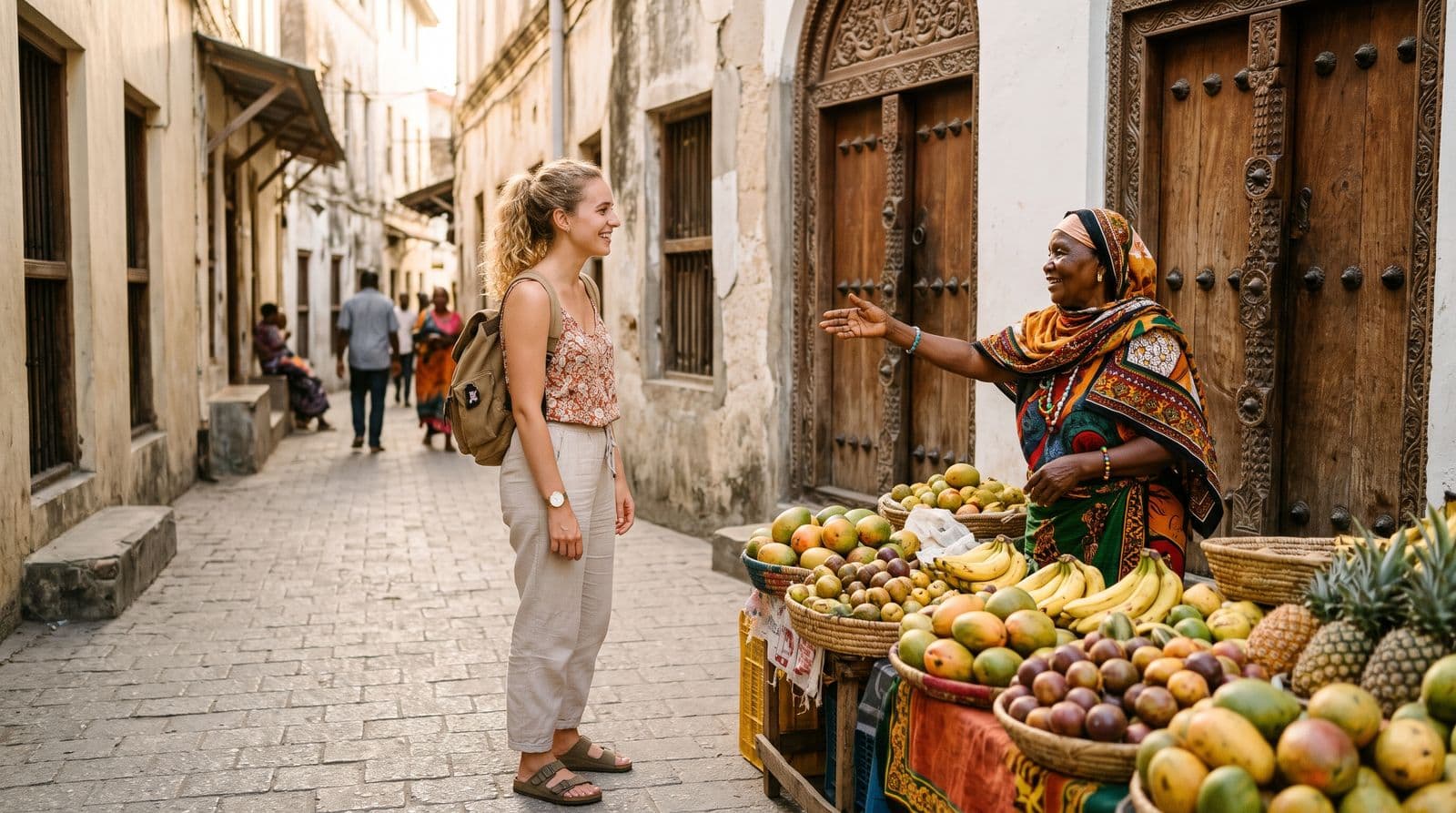
You do not need to be fluent to have a good trip to Kenya or Tanzania. English will get you through hotels, airports and most taxis. But a handful of Swahili phrases changes how people treat you. Prices soften, conversations start, and the person serving you stops seeing a tourist and starts seeing a guest.
This guide is the short list. These are the phrases you will use every single day, with the replies you will hear back, so you are not caught off guard when someone answers.
Rule one: greet before you ask
The biggest mistake visitors make is not a grammar mistake. It is walking up to someone and asking a question straight away. In East Africa, you greet first, every time. Asking for directions without a greeting feels as rude as not saying please.
So the pattern is always: greeting, a moment of small talk, then your question. It takes ten seconds and it makes everything that follows easier.
Greetings you will use every day
- Habari? (How are things?) The reply is almost always nzuri (good), even on a bad day.
- Habari za asubuhi? (How is your morning?) Swap asubuhi for mchana (afternoon) or jioni (evening).
- Hujambo? (How are you?) The reply is sijambo (I am fine). This is the more formal pair.
- Mambo? The relaxed greeting between peers. Reply poa (cool). Use it with people your age, not with elders.
- Shikamoo is the respectful greeting for anyone clearly older than you, used especially in Tanzania and on the coast. They will reply marahaba. We wrote a whole post on why this one matters so much.
You will also hear karibu constantly. It means welcome, and it is said as you walk into a shop, a home or a restaurant. Reply with asante (thank you).
The polite words
- Tafadhali (please)
- Asante (thank you) and asante sana (thank you very much)
- Samahani (excuse me, or sorry). Use it to get someone's attention or to squeeze past in a crowd.
- Pole (sorry for your trouble). People say this when you trip, look tired or mention a long journey. It is sympathy, not an apology. Reply asante.
- Naomba (may I have). This is the polite way to ask for anything. Naomba maji means "may I have some water, please." It sounds much softer than "I want."
Hakuna matata is real Swahili, but you will mostly hear it from people talking to tourists. Locals are more likely to say hakuna shida (no problem) or simply sawa (okay).
Getting around
- Iko wapi? (Where is it?) Put the place first: Hoteli iko wapi? (Where is the hotel?)
- Choo kiko wapi? (Where is the toilet?) Probably the most useful sentence in this whole post.
- Nataka kwenda... (I want to go to...) Then the place name.
- Simama hapa, tafadhali (Stop here, please). Useful in a taxi, a tuk-tuk or a matatu.
- Polepole (slowly). You will hear this a lot. It is also a whole philosophy of life on the coast.
- Ni mbali? (Is it far?) The answer might be karibu again, which here means nearby.
Shopping and the market
Bargaining is normal in markets and with street sellers, though not in supermarkets or most restaurants. A few words of Swahili usually gets you a better starting price than English alone.
- Bei gani? (What is the price?)
- Ghali sana! (Very expensive!) Say it with a smile. It is part of the game.
- Punguza kidogo (Reduce it a little)
- Nitachukua (I will take it)
- Sitaki, asante (I do not want it, thank you). Polite and firm, for persistent sellers.
Numbers you need for prices
- moja (1), mbili (2), tatu (3), nne (4), tano (5)
- sita (6), saba (7), nane (8), tisa (9), kumi (10)
- mia (hundred) and elfu (thousand)
Prices are said with the big unit first. Elfu mbili is two thousand shillings. Mia tano is five hundred. Once you know mia and elfu, most market prices make sense.
Food and drink
- Naomba chai (May I have tea). Kenyan chai comes milky and sweet unless you ask otherwise.
- Maji ya chupa (bottled water)
- Chakula ni kitamu sana (The food is very tasty). Cooks love hearing this.
- Sili nyama (I do not eat meat)
- Bila pilipili (Without chilli)
- Naomba bill (May I have the bill)
When you get stuck
- Sielewi (I do not understand)
- Sema tena, polepole (Say it again, slowly)
- Unaongea Kiingereza? (Do you speak English?)
- Msaada! (Help!)
Do not be embarrassed to use these. Trying Swahili and then asking for help is far better received than not trying at all. People are genuinely pleased when a visitor makes the effort.
A note on Swahili time
If someone tells you the bus leaves at saa moja, do not turn up at one o'clock. Swahili time starts counting at dawn, around 7am. So saa moja asubuhi is 7am, and saa nne is 10am. Add six hours to the Swahili number and you will be roughly right. When in doubt, ask for the time "kwa saa za kizungu" (in English time).
Saying goodbye
- Kwaheri (Goodbye) and kwaherini when saying it to a group
- Tutaonana (We will see each other)
- Lala salama (Sleep well)
- Safari njema (Have a good journey). You will hear this one as you leave, and it is a lovely thing to say back to fellow travellers.
How to practise before you fly
Reading phrases is a start, but the sounds are what make them stick. Swahili is very regular to pronounce: every letter is said, vowels are short and clear, and the stress almost always falls on the second to last syllable. Hear a phrase a few times and you will be able to say it.
That is exactly what the Learn Swahili app is built for. The lessons and phrasebook let you hear greetings, numbers and everyday phrases spoken aloud, and Mwalimu, the in-app tutor, will happily role-play a market haggle or a taxi ride with you before you land. A few minutes a day for two weeks before your trip is enough to walk off the plane greeting people properly.
Karibu Afrika Mashariki. Welcome to East Africa.